Euchre is a 4-player partnership card game played with a 24-card deck. Each round, one suit becomes trump — and the two Jacks (called Bowers) are the most powerful cards in the game. Players bid for the right to name trump, then play 5 tricks. First team to 10 points wins. You can learn to play in about 10 minutes.
Euchre is one of the most satisfying card games you can learn. It’s fast (20–30 minutes a game), strategic, and built around a partnership — you and your teammate working together to outsmart the other pair. The rules are simple enough to explain in minutes, but there’s real depth once you start thinking about bidding, trump management, and reading your partner’s plays.
This guide is designed for players who have never played euchre before. By the end, you’ll understand the deck, the goal, the unique bower system, how a hand plays out, and how to score — everything you need to sit down and play your first game with confidence.
What You Need
- 4 players — 2 teams of 2, partners sitting across from each other
- A 24-card deck — a standard deck with all 2s through 8s removed (keep 9, 10, J, Q, K, A of each suit)
- Something to keep score — paper and pencil, or two low cards from another deck
That’s it. No board, no tokens, no special equipment.
The Goal
Be the first team to reach 10 points.
Points come from winning tricks. Each hand, one suit is trump. The team that calls trump (names the trump suit) is betting they can win at least 3 of the 5 tricks that hand. Win enough hands, reach 10 points first, win the game.
Understanding the Euchre Deck
The 24-card deck contains the 9, 10, Jack, Queen, King, and Ace of all four suits:
| Suit | Cards |
|---|---|
| ♠ Spades | 9 10 J Q K A |
| ♥ Hearts | 9 10 J Q K A |
| ♦ Diamonds | 9 10 J Q K A |
| ♣ Clubs | 9 10 J Q K A |
Without a trump suit, cards rank in the usual order: 9 (low) → 10 → J → Q → K → A (high).
When a trump suit is called, that changes — and the Jacks become the most powerful cards in the game.
The Bower System — The Key to Euchre
This is the part that confuses most beginners, but it’s actually quite simple once you see it.
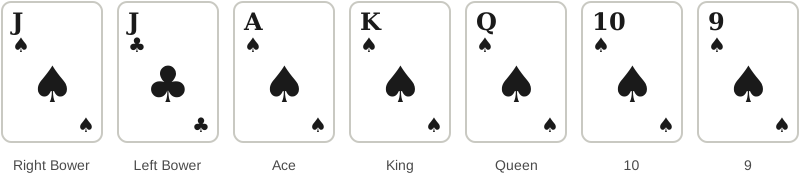
When a trump suit is called, two Jacks become the highest-ranking cards in the deck:
- Right Bower — the Jack of the trump suit. Highest card in the game.
- Left Bower — the Jack of the same color as trump, from the other suit. Second-highest card.
Example: Hearts are trump.
- Jack of Hearts = Right Bower (highest card)
- Jack of Diamonds = Left Bower (second highest) — because diamonds are also red
- All other hearts rank: A → K → Q → 10 → 9
Example: Spades are trump.
- Jack of Spades = Right Bower (highest)
- Jack of Clubs = Left Bower (second highest) — because clubs are also black
The Left Bower temporarily belongs to the trump suit for the entire hand. So if spades are trump, the Jack of Clubs acts as a spade — not a club — for all purposes.
Why does this matter? Because it means trump has 7 cards total: the Right Bower, Left Bower, Ace, King, Queen, 10, and 9 of the trump suit. Holding both Bowers gives you the two most powerful cards in the game.
How a Hand Works
1. Deal
The dealer gives each player 5 cards (clockwise, in rounds of 2 and 3, or 3 and 2). The remaining 4 cards go face-down in the center — this pile is called the kitty. The top card is flipped face-up.
2. Bid for Trump (Round 1)
Starting with the player to the dealer’s left, each player either:
- Orders it up — tells the dealer to pick up the face-up card, making that card’s suit trump. The dealer picks it up and discards a card.
- Passes — declines the face-up card’s suit as trump.
If all four players pass, the face-up card is turned down and you move to Round 2.
3. Bid for Trump (Round 2)
Starting again from the player left of the dealer, each player may name any other suit as trump (not the suit of the turned-down card). If all four pass again, the hand is redealt (or the dealer must name trump if playing “Stick the Dealer”).
The player who calls trump — and their partner — become the makers. They must win at least 3 tricks to score.
4. Play 5 Tricks
The player left of the dealer leads any card. Play goes clockwise. The rules:
- You must follow suit — if you have any card of the led suit, you must play it.
- If you can’t follow suit — you may play any card, including trump.
- Highest trump wins the trick — if trump was played.
- Highest card of the led suit wins — if no trump was played.
- The trick winner leads the next trick.
Remember: the Left Bower belongs to the trump suit. If clubs are led and spades are trump, the Jack of Clubs must be played as trump — not as a club.
5. Score the Hand
| Outcome | Who Scores | Points |
|---|---|---|
| Makers win 3 or 4 tricks | Makers | 1 point |
| Makers win all 5 tricks (march) | Makers | 2 points |
| Going alone, win all 5 tricks | Maker (solo) | 4 points |
| Makers win fewer than 3 tricks (euchred) | Defenders | 2 points |
6. Rotate the Deal
The deal passes clockwise. Keep playing hands until one team reaches 10 points.
Going Alone
Instead of playing with your partner, you can declare you’re going alone when you call trump. Your partner sits out that hand. If you win all 5 tricks solo, your team earns 4 points instead of 2. If you only win 3 or 4, you earn 1 point. Going alone is a big risk — only try it when your hand is nearly unbeatable (typically when you hold both Bowers and at least one other high trump).
Common Beginner Mistakes
Calling trump on too few trump cards. You need at least 3 trump cards — ideally including a Bower — to reliably win 3 tricks. Calling trump on 2 trump cards often results in getting euchred and giving the opponents 2 points.
Forgetting the Left Bower. The Jack of the same color as trump belongs to the trump suit. New players often forget this and are surprised when it beats their ace.
Not leading trump when you called it. When you called trump, one of your best moves is usually to lead trump immediately to draw out the opponents’ trump cards. Saving trump too long gives the opponents a chance to use theirs against you.
Playing every card you can to win a trick. Sometimes the right play is to let your partner win a trick rather than using a high trump unnecessarily. Trust your partner.
Ordering up the wrong suit. Ordering up trump because the turned card looks good — without checking how it helps your hand — is a common mistake. Think about whether your hand wins 3 tricks with that suit as trump before ordering.
What to Learn Next
Once you’ve played a few hands, these guides will take your game further:
- Card Rankings — Full trump hierarchy with visual examples of every scenario
- Scoring Guide — Detailed breakdown of every scoring situation
- Bidding Strategy — When to call, when to pass, and when to order up your partner
- Euchre Tips — 15 practical tips that immediately improve your game
- Practice vs Computer — Play hands at your own pace to build familiarity
- Play Online Free — Join a multiplayer game once you’re ready for real opponents
Frequently Asked Questions
Is euchre hard to learn?
No — euchre is one of the easiest trick-taking card games to learn. Most beginners can understand the rules in about 10 minutes and play a full game within their first session. The main thing to learn is the bower system (two special Jacks that rank above the others when trump is called), but once that clicks, everything else follows naturally.
How many people do you need to play euchre?
Standard euchre requires exactly 4 players divided into 2 teams of 2, with partners sitting across from each other. Variations exist for 2 players (Two-Handed Euchre) and 3 players (Three-Handed Euchre).
What cards do you use for euchre?
Euchre uses a 24-card deck — the 9, 10, Jack, Queen, King, and Ace of each of the four suits. Remove all 2s through 8s from a standard 52-card deck. That's it.
What is the goal of euchre?
Win the most tricks after naming trump. The team that calls trump (the makers) must win at least 3 of the 5 tricks to score a point. Win all 5 for 2 points. If you fail to win 3 tricks, the other team scores 2 points (this is called being euchred). First team to 10 points wins the game.
What is a bower in euchre?
The two Jacks are called Bowers and are the most powerful cards in the game when trump is called. The Jack of the trump suit is the Right Bower (highest card in the game). The Jack of the same color as trump — but the other suit — is the Left Bower (second-highest card). For example, if hearts are trump, the Jack of Hearts is the Right Bower and the Jack of Diamonds is the Left Bower.