A farmer's hand is a euchre hand with no face cards or aces: only 9s and 10s (sometimes defined as three or more 9s and 10s). It's a house rule, not a standard rule. Depending on the table, the player may show it and call for a redeal, swap three cards with the kitty, or simply play it. Agree before the game which version you use.
A farmer’s hand is the worst hand in euchre: five cards with no face cards and no aces, only 9s and 10s. Some tables give the unlucky player a way out, but it’s a house rule, not part of standard euchre. If you’re sitting down with a new group, ask whether they “play farmer’s” before the first deal.
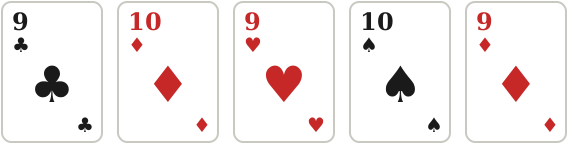
The Three Common Versions
1. Farmer’s redeal (simplest)
Before bidding starts, the player shows the hand face-up and the same dealer redeals. Some tables limit this to once per hand so it can’t loop.
2. Farmer’s swap (most common)
Before bidding, the player announces “farmer’s hand” and swaps three cards for the three face-down kitty cards (the turned-up card stays). The player shows the three cards they give up. Bidding then goes ahead normally.
3. No farmer’s
The hand is played like any other. This is standard euchre, and it’s what most tournaments use.
Common Definitions
| Definition | How often you’ll get it |
|---|---|
| All five cards are 9s and 10s | about 1 in 760 hands |
| Three or more 9s and 10s, no aces | about 1 in 9 hands (10.8%) |
The strict version is so rare that many players have never seen one. The looser version comes up about once a game (a game to 10 is usually 10–15 hands), which is why tables that use it usually choose the swap rule instead of a full redeal.
How we calculated it: there are eight 9s and 10s in the 24-card deck. Five of them: C(8,5) = 56 hands out of C(24,5) = 42,504. For the loose rule: hands with no aces and at least three of the eight 9s/10s = 56×66 + 70×12 + 56 = 4,592 hands, or 10.8%.
Should Your Table Use It?
Pros: it gives weak hands a way out, and it’s popular with casual groups and newer players.
Cons: it adds luck rather than removing it. A farmer’s hand as a defender isn’t a disaster, because your partner and the defensive strategy do the work. And the swap version reveals kitty information that affects everyone’s bidding.
Most serious players skip it. For a relaxed family game, the swap is harmless fun. For other rules you may run into, see the full list of euchre house rules.
Frequently Asked Questions
What is a farmer's hand in euchre?
A hand made up entirely of 9s and 10s, with no face cards or aces. Some groups use a looser definition: any hand with three or more 9s and 10s and no aces.
Is a farmer's hand an official euchre rule?
No. It is a common house rule, especially in the US Midwest. Standard euchre has no special treatment for weak hands, so always confirm whether your table uses it.
What happens if you have a farmer's hand?
It depends on the house rule. The three common versions: show the hand and redeal (same dealer), swap three of your cards for the three face-down kitty cards, or ignore it and play normally.
How often do you get a farmer's hand?
Rarely. There are eight 9s and 10s in the 24-card deck, so a hand of five of them happens C(8,5)/C(24,5) = 56/42,504, about once in every 760 hands. The looser 'three or more 9s and 10s, no aces' definition happens in about 1 of every 9 hands (10.8%).
Can you order up with a farmer's hand?
Under the swap rule, you must declare the farmer's hand before bidding starts, then swap. After the swap you bid normally with your new hand.